
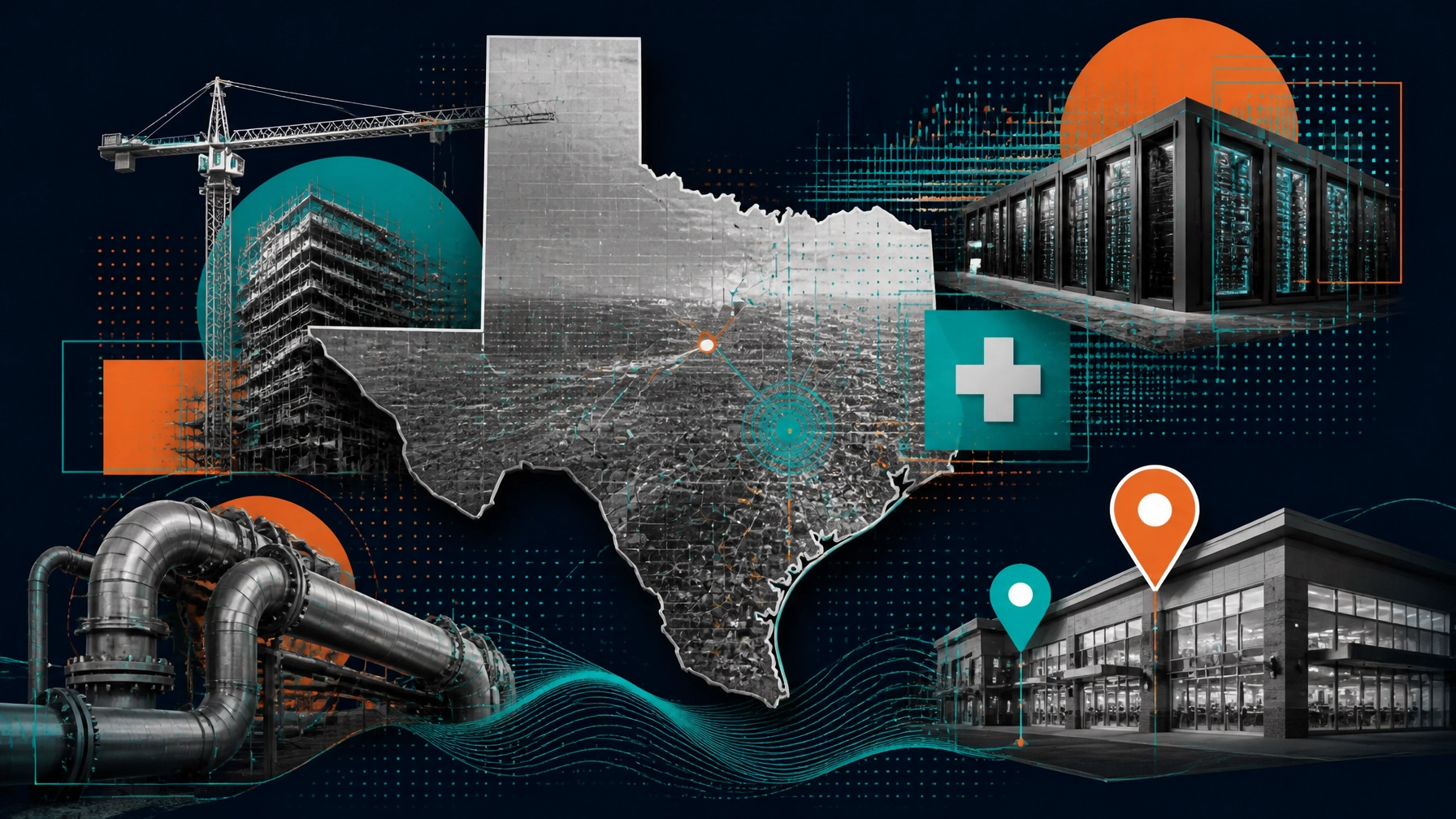
Texas is not simply one of the strongest states in the United States. It is a global-scale commercial market.
If Texas were an independent economy, its output would rank among the largest in the world. In 2025–2026, the state’s GDP is approaching $2.9 trillion, while nonfarm employment has exceeded 14.4 million jobs. The state continues to attract companies, workers, capital, and major infrastructure projects.
For businesses ready to scale, this creates a powerful opportunity. But opportunity alone does not guarantee growth.
Texas is competitive. Buyers research online before they contact a provider. Patients compare healthcare organizations through search. Contractors compete for high-value bids. Restaurants and retailers must win attention during precise days and times.
The companies that grow fastest will connect local market intelligence with strong branding, AI marketing services, search visibility, and measurable advertising.
This is the focus of Pillar 3 in the Iktika High-Authority Content Series: Texas Market Entry & Sector Dynamics: 2026 Outlook.
Why Texas Is a High-Opportunity Market in 2026
Texas combines several growth advantages:
- More than 9 million new residents added over the past two decades.
- Strong population growth across Dallas–Fort Worth, Houston, Austin, San Antonio, and emerging regional markets.
- A diverse economy supported by energy, technology, manufacturing, healthcare, construction, and tourism.
- Major public and private investment in transportation, housing, utilities, industrial facilities, and data centers.
- A business environment that continues to attract corporate relocations and entrepreneurial investment.
The Texas Economic Snapshot reflects the scale of the state’s economy. Meanwhile, the Texas Workforce Commission continues to report record employment levels.
This combination creates demand across four powerhouse sectors.
1. Construction and Infrastructure: Build Visibility Before the Bid
Texas construction is being driven by population growth, industrial expansion, housing demand, utility upgrades, and technology infrastructure.
The state’s data-center boom is a clear example. Abilene’s Stargate initiative illustrates how artificial intelligence is creating demand for enormous campuses, power systems, site preparation, electrical infrastructure, cooling systems, security, and specialized construction services. Reporting from Texas Standard and CNBC shows why projects of this scale are reshaping regional economies.
For contractors, the opportunity is substantial. So is the competition.
Construction companies need a stronger digital foundation
Commercial buyers, developers, architects, and facility managers increasingly use Google and AI answer engines to identify qualified contractors. A website that only lists services is no longer enough.
Contractors should prioritize:
- LocalBusiness schema with accurate business details, service areas, licenses, and contact information.
- Project pages that identify location, project type, scope, materials, and measurable outcomes.
- Answer Engine Optimization, or AEO, using direct question-and-answer sections.
- Technical content for high-value searches such as industrial construction, healthcare facilities, data centers, civil infrastructure, and commercial development.
- Consistent business listings across Google Business Profile and relevant industry directories.
- Case studies that demonstrate reliability, safety, timelines, and project results.
Our guide on AEO vs. SEO for Texas construction companies explains how contractors can become more visible in both traditional search and AI-generated recommendations.
At Iktika Media, complex brand and web projects should be organized into clear digital systems. A contractor’s website should function as a sales tool, not a digital brochure.

2. Healthcare and Life Sciences: Scale Patient Acquisition Responsibly
Texas healthcare organizations serve a growing and increasingly diverse population. New residents, expanding suburbs, aging communities, specialty care demand, and multi-location healthcare groups all create opportunities for patient growth.
However, healthcare marketing requires more than aggressive advertising. It requires trust, accessibility, privacy, and compliance.
Patient growth depends on trust and convenience
Patients want to find the right provider quickly. They also expect clear information, accessible websites, multilingual support, and easy appointment pathways.
Healthcare organizations should focus on:
- Local-intent search optimization for services, conditions, specialties, and locations.
- Mobile-first landing pages with clear calls to action.
- Accessible website experiences that support users with disabilities.
- Educational content that answers common patient questions without making unsupported clinical claims.
- HIPAA-compliant systems when protected health information is collected or processed.
- AI governance based on frameworks such as the NIST AI Risk Management Framework.
For patient acquisition, a healthcare provider can use AI for general educational content and top-of-funnel marketing without handling protected health information. When an AI system manages appointment details, insurance information, or other PHI, the workflow requires appropriate safeguards, vendor agreements, access controls, encryption, audit logs, and defined retention policies.
A HIPAA-compliant AI callbot can support healthcare organizations with:
- 24/7 inbound call handling.
- Appointment scheduling.
- Basic administrative questions.
- Multilingual support.
- Human-agent escalation.
- Secure intake and routing workflows.
This technology belongs in the healthcare context, where it can reduce friction between marketing-generated demand and appointment conversion. Hospitality businesses require a different approach, which we address later.
Our healthcare digital marketing strategy guide explores how compliance and growth can work together.
Iktika Media leads strategy that connects technology with a clear brand purpose. The goal is not to automate every interaction. The goal is to make the patient journey more responsive while preserving human trust.
3. Oil, Gas, and Industrial Evolution: Market Reliability, Not Just Capability
Texas remains the undisputed energy capital of the United States. Oil, gas, petrochemicals, manufacturing, logistics, renewables, and industrial services continue to support a large network of operators, EPC firms, engineering companies, and technical suppliers.
The market is evolving. Buyers now expect operational reliability alongside innovation.
Industrial companies must communicate how their services improve:
- Uptime.
- Safety.
- Compliance.
- Maintenance.
- Productivity.
- Cost control.
- Infrastructure reliability.
- Energy transition readiness.
Generic claims such as “leading solutions” or “quality service” are not persuasive enough for B2B buyers. Industrial decision-makers want evidence.
Build authority through technical content
A strong industrial marketing program should include:
- Technical explainers based on real operational problems.
- Case studies with quantified results.
- Executive thought leadership on LinkedIn.
- Search content for specialized services and equipment.
- Content that references relevant Texas markets, such as the Permian Basin, Eagle Ford, Gulf Coast, Houston, and Corpus Christi.
- Clear messaging for engineers, procurement teams, plant managers, and executives.
The Texas Oil & Gas Association and the Texas Comptroller’s industry analysis provide useful context on the sector’s economic importance.
In this market, digital messaging must reflect the way operations actually work. Authentic facilities, equipment, and field environments create more credibility than generic stock imagery.
4. Hospitality and Retail: Convert Visitor Spending Into Predictable Revenue
Texas tourism and consumer spending remain strong. Travel spending reached approximately $97.5 billion in 2024, according to state tourism research, while major destinations continue to attract leisure travelers, business visitors, event attendees, and local consumers.
But hospitality demand is uneven.
A restaurant may be full on Friday night and slow on Tuesday afternoon. A hotel may perform well during a convention but struggle between events. A retail location may see strong weekend traffic but need more weekday visits.
This is where targeted advertising becomes a growth system.
Use geofencing and dayparted Google Ads
Hospitality and retail brands should combine:
- Geofencing around hotels, convention centers, stadiums, entertainment districts, airports, and competitor locations.
- Google Search campaigns for high-intent local queries.
- Dayparting based on actual sales and foot-traffic data.
- Promotions designed for specific days and hours.
- Separate campaigns for residents, business travelers, tourists, and event audiences.
- English and Spanish creative where local demographics support it.
For example, a restaurant could run:
- Monday and Tuesday campaigns from 3:00 p.m. to 6:00 p.m. promoting a limited-time early dinner offer.
- Wednesday campaigns targeting nearby offices with an express lunch promotion.
- Event-day campaigns around a stadium or convention center.
- Weekend campaigns focused on reservations, group dining, or premium experiences.
Our guides on geofencing and Google Ads and turning slow restaurant days into profit centers provide practical campaign examples.
Campaigns should connect location, timing, audience intent, creative, and conversion data. The objective is not to generate impressions. It is to generate profitable visits.

The Texas Growth Advantage Is Local Execution
Texas is large enough to contain multiple markets within one state. Houston is not Dallas. Austin is not Abilene. A healthcare campaign in San Antonio should not use the same messaging as an industrial campaign in the Permian Basin.
Successful market entry requires:
- A clear sector-specific value proposition.
- Local search and entity optimization.
- High-quality brand content.
- Paid media built around commercial intent.
- Responsible AI implementation.
- Strong public relations and third-party credibility.
- Measurement tied to leads, appointments, bids, visits, and revenue.
Public relations helps brands build authority beyond their owned channels. Press coverage, executive visibility, community relationships, and credible industry mentions can strengthen both reputation and search visibility.
In 2026, audiences also value real content. AI can improve speed, analysis, personalization, and automation. It cannot replace human creative direction, real photography, or genuine expertise.
That is why Iktika combines strategy, design, content creation, PR, advertising, web development, and AI marketing services in one integrated system.
Scale Your Texas Business With Iktika Media
Texas offers exceptional room for growth across construction, healthcare, energy, industrial services, hospitality, and retail.
The winners will not rely on market momentum alone. They will build a visible, credible, conversion-focused presence that matches how Texas buyers search and make decisions.
Iktika Media helps businesses connect strategy, creativity, technology, and local market intelligence. Explore our full range of marketing services, review our portfolio, or contact our team to discuss your next stage of growth.
Written by the Iktika Media Strategy Team
Isabel Zetina
Owner & Creative Director, Iktika Media LLC