In the hospitality industry, Saturdays are often treated as the ultimate prize, usually claiming nearly 27% of your weekly revenue. But while your team is stretched thin during the weekend rush, a silent opportunity is sitting right in the middle of your week.
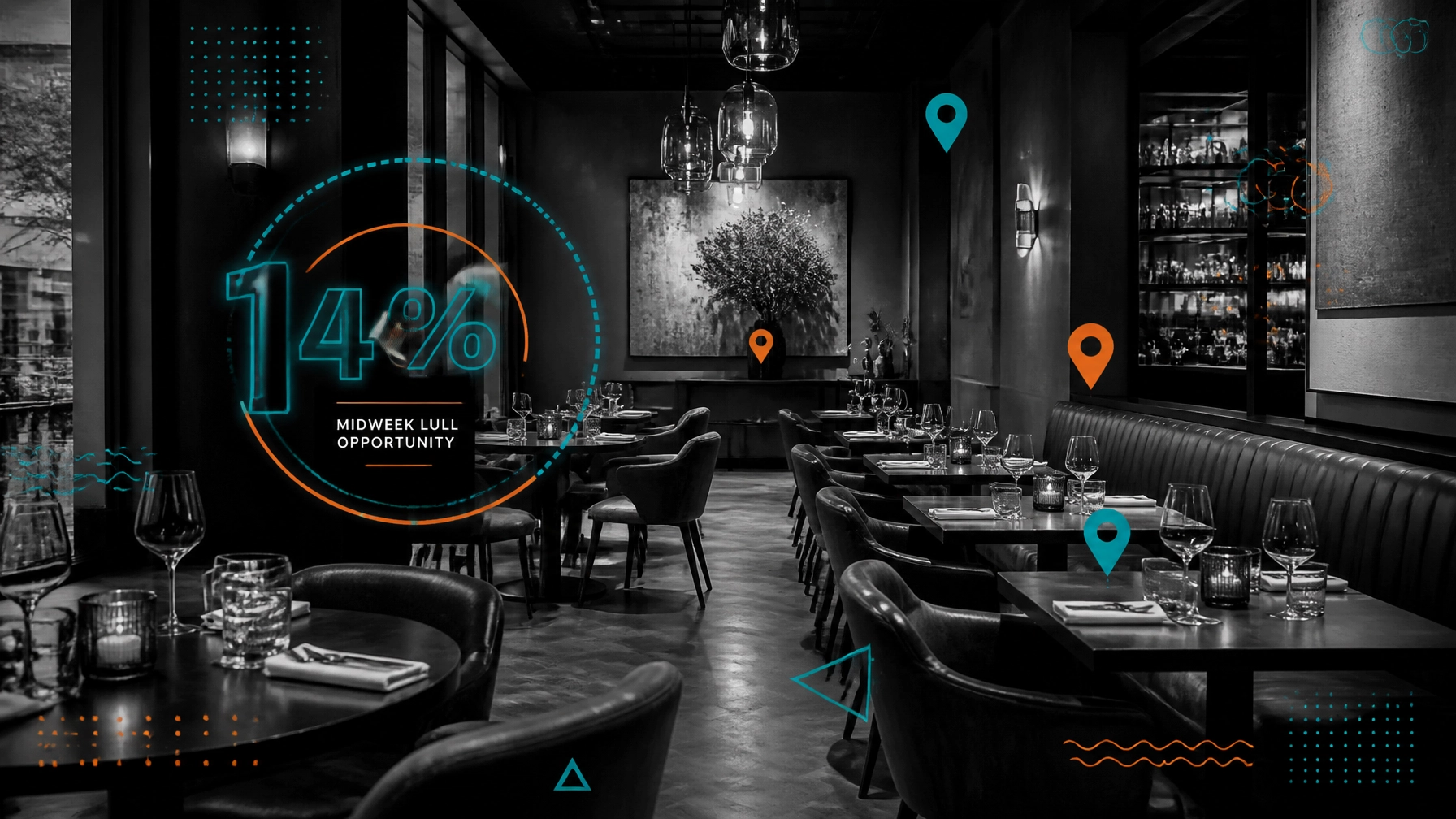
According to 2026 data from Tableo and Nouz, Thursday typically generates only 13-14% of weekly revenue. While it outperforms the Monday "slump" (6%) and Tuesday (8%), Thursday represents a strategic "revenue gap": a day where your kitchen is prepped, your staff is scheduled, but your tables aren't at capacity.
At Iktika Media, led by our Agency Strategy specialist Isabel Zetina, we view Thursday not as a slow day, but as an underrated profit center. By combining the precision of Geofencing with the intent-driven power of Google Ads, we are helping restaurants bridge this gap and turn midweek lulls into consistent revenue.
The Data: Why Thursday is the "Underrated Workhorse"
The 2026 restaurant landscape is defined by cautious consumer spending and high operational costs. The Census Bureau’s May 2026 report shows that while food services are up 2.7% year-over-year, inflation-adjusted sales actually declined by 0.9%. This means traffic, not price, is the real challenge.
However, the TouchBistro 2026 American State of Restaurants Report highlights a shifting pattern: as the return-to-office trend solidified in late 2025 and 2026, the Tuesday-Friday dinner window has become "particularly busy" for hybrid workers. Restolabs Analytics further identifies Thursday as an "underrated workhorse": showing that a strong marketing push on Thursday afternoon not only fills seats that night but also acts as a primary driver for Friday and weekend bookings.

Solution 1: Precision Geofencing Around Office Districts
If your restaurant is within a 3-5 mile radius of a corporate hub or a commercial district, you are sitting on a goldmine. Geofencing allows you to create a virtual "fence" around these buildings. When a professional in the 25-44 age bracket enters that zone, they receive a targeted notification or see a display ad specifically designed for their Thursday reality.
Iktika Case Study: The Power of Localized Triggers
In a recent campaign managed by Cecy Madero, our ADS and Social Media Specialist, we deployed a geofencing strategy for a high-end hospitality client. The results were staggering:
- 6x lower CPM than standard Google Display Ads.
- 25,000+ targeted users reached within their work environment.
- 1,600+ in-store visits directly attributed to the geofence.
- 9% visitation rate (meaning 1 in 11 people who saw the ad walked through the doors).
By targeting office clusters between 11:00 AM and 4:00 PM on Thursdays, we capture the "After-Work" and "Team Dinner" decision-makers at the exact moment they are looking for an escape from the office.
Geofencing by Time of Day: Lunch, After-Work, and Dinner Windows
The strongest geofencing campaigns do not run one generic ad all day. They shift message, offer, and urgency based on the hour.
Lunch window (10:30 AM-1:30 PM):
- Target nearby office towers, medical campuses, mixed-use developments, and coworking spaces.
- Promote fast-decision offers such as business lunch specials, chef lunch menus, or team lunch bookings.
- Use copy like: "Out of the office by noon? Lunch special 2 blocks away."
- Focus on convenience, speed, and proximity.
After-work window (3:00 PM-5:00 PM):
- Retarget the same professionals as they start thinking about where to unwind.
- Promote Thursday-only happy hours, Wine-Down Wednesdays, Thirsty Thursdays, and midweek chef specials.
- Use copy like: "Clocking out soon? Happy hour starts at 4."
- Focus on mood shift, reward, and group momentum.
Dinner window (5:00 PM-7:30 PM):
- Serve creatives that support dinner reservations, team dinner packages, client dinners, and wine pairings.
- Highlight atmosphere, premium dishes, and easy reservation intent.
- Use copy like: "Team dinner tonight? Reserve your table before 6 PM."
- Focus on status, experience, and immediate action.
This is where campaign structure matters. A lunch audience is not looking for the same message as a 5:30 PM team lead planning an after-work dinner. Effective geofencing turns location data into hour-specific ad relevance.
Solution 2: Google Ads with Thursday-Specific Creative
While geofencing handles discovery, Google Ads captures intent. When someone searches for "best happy hour near me" or "dinner specials tonight," your creative must be hyper-specific.
Under the visual direction of Daniel (Dany) de la Torre, our Project Manager and Visual Specialist, and the professional photography of Didier, we move away from generic food photos. For Thursday campaigns, we prioritize:
- Midweek Chef Specials: Highlighting limited-edition items available only on Thursdays.
- Corporate "Escape" Packages: Visuals that emphasize a sophisticated atmosphere for team bonding.
- Real Visual Identity: Using high-quality, real photography to build trust with corporate clients who value authenticity over AI-generated stock.
How to Structure Google Ads by Daypart
One campaign is not enough. Strong restaurant advertising separates intent by hour and aligns keywords, ad copy, extensions, and landing page messaging with the decision happening in that moment.
Morning coffee or early-planning ads (7:00 AM-10:30 AM):
- Capture searches from professionals planning their day.
- Keywords: lunch near office, team lunch spot, restaurant near downtown office.
- Creative angle: convenience, reservations, and pre-planned meetings.
- Example headline: Plan Lunch Near the Office Today
Lunch-special ads (10:45 AM-1:30 PM):
- Increase bids just before peak lunchtime searches.
- Keywords: lunch specials near me, business lunch restaurant, chef lunch special.
- Creative angle: speed, location, and value.
- Example headline: Lunch Specials Starting at 11 AM
Happy hour trigger ads (3:00 PM-5:00 PM):
- Build campaigns specifically for after-work intent.
- Keywords: happy hour near me, after work drinks, Thursday happy hour.
- Creative angle: urgency and social reward.
- Example headline: Happy Hour Starts at 4 PM Today
Dinner reservation ads (5:00 PM-8:00 PM):
- Capture high-intent evening searches.
- Keywords: dinner reservations tonight, restaurant for team dinner, wine bar near me.
- Creative angle: ambiance, premium experience, and availability.
- Example headline: Reserve Dinner for Tonight
Google Ads scheduling lets you run these creatives at different hours, with different bid adjustments, so the person searching at 8:15 AM does not see the same message as the person searching at 5:20 PM.
Promotion Types That Perform in Midweek Campaigns
Restaurant ads perform better when the offer is concrete, weekly, and memorable. Generic "come dine with us" messaging rarely wins. Specific promotions do.
High-performing examples include:
- Thursday-only happy hours
- Midweek chef specials
- Team dinner packages
- Wine-Down Wednesdays
- Thirsty Thursdays
- Corporate unwind menus
- Pre-weekend tasting nights
These offers work because they give people a reason to act today, not eventually. They also create a repeatable promotion cadence your audience can remember week after week.
Segment Campaigns by Day of Week
Restaurants should not treat Tuesday, Wednesday, and Thursday as interchangeable. Each day can carry its own theme, audience, and creative set.
A practical weekly structure looks like this:
- Monday win-back: Retarget recent visitors with a softer incentive to return this week.
- Tuesday tasting: Promote chef tastings, pairings, or lower-friction trial offers.
- Wednesday wine: Push wine flights, pairings, and "Wine Wednesday" creative.
- Thursday thirsty: Run stronger happy hour and after-office social messaging.
- Friday weekend preview: Tease premium reservations, group dining, and weekend energy.
This segmentation improves CTR and conversion rate because the ad feels current, timely, and intentional. It also helps operators map promotions to kitchen flow, staffing, and beverage margins.

The "Two Moment Strategy"
To maximize ROI, Iktika recommends a tiered approach that aligns with the consumer’s psychological journey:
- Moment 1 (Discovery): Use Geofencing during work hours to plant the seed. This is where Viri Maldonado, our PR expert, ensures the brand's reputation and "vibe" are communicated effectively to nearby professionals.
- Moment 2 (Intent): Use Google Ads and Social Media Retargeting (Facebook/Instagram) at 5:00 PM to provide the "trigger" to book.
This strategy ensures that your restaurant is the first choice when the "Where should we go?" question inevitably arises in the office Slack channel.
Expanded Example: What the Two Moments Actually Look Like
The best-performing campaigns connect exposure at one moment to action at the next.
Moment 1: Lunch-hour geofence exposure
- A downtown office employee walks through a geofenced business district at 12:15 PM.
- They see a display ad that says: "Team lunch today. Happy hour later. Two blocks away."
- The goal is not always the immediate click. The goal is brand memory and offer awareness.
Moment 2: Afternoon retargeting and search capture
- That same user later searches happy hour near me or team dinner tonight around 4:00 PM.
- Your Google Ad appears with a stronger CTA: "Thursday Happy Hour 4-6 PM | Reserve Your Table"
- If they do not search, they can still receive a retargeted display or paid social ad reminding them that the promotion begins soon.
This is where retargeting becomes powerful. Someone who saw the geofence ad at lunch gets a follow-up Google Ad at 4:00 PM for happy hour. The first ad creates familiarity. The second ad converts intent.
Use Google Ads Scheduling to Match Creatives to Hours
Ad scheduling is one of the most underused tools in hospitality media buying. Instead of running one static message all day, schedule different ad groups and assets to match the dining occasion.
For example:
- Before 11:00 AM: Show lunch planning creatives.
- 11:00 AM-2:00 PM: Show lunch specials and quick-book messages.
- 3:00 PM-5:00 PM: Switch to happy hour creative with urgency.
- 5:00 PM-8:00 PM: Prioritize dinner reservation ads and team dining packages.
This structure lets Cecy optimize bids by hour, while Dany and Didier ensure each creative looks premium, real, and on-brand. It also gives Isabel Zetina a clear strategic framework for turning promotions into a repeatable revenue engine.
Promotion Cadence Builds Habit
A strong Thursday campaign is even more effective when it sits inside a predictable weekly rhythm. Consistent themes train your audience to remember what happens on each day.
Examples of effective cadence include:
- Taco Tuesday
- Wine Wednesday
- Thirsty Thursday
- Friday Weekend Preview
This cadence matters because repetition builds recall. Recall drives clicks. Clicks drive covers. A restaurant that promotes the same weekly rhythm with disciplined ad scheduling has a better chance of owning a specific occasion in the customer's mind.
Aligning Campaigns to Inventory
The ultimate goal of a Thursday strategy is inventory management. If your data shows that Thursday is consistently at 50% capacity, the objective is clear: fill those seats at any margin. Whether it’s a "Wine & Liquor" promotion or a specialized "Hospitals & Corporate" lunch menu, your marketing spend should be a surgical tool that targets your slowest hours.
The most efficient way to do that is to align promotions with specific dayparts and weekly demand patterns:
- Push Monday win-back campaigns when you need to restart traffic.
- Use Tuesday tasting or chef-special campaigns to create low-friction midweek trial.
- Lean into Wednesday wine promotions for beverage-led margin.
- Own Thursday thirsty with after-work geofencing, happy hour creatives, and team dinner packages.
- Launch Friday weekend preview ads to fill premium evening inventory before competitors do.
This turns media spend into a coordinated sales calendar rather than a generic awareness tactic.
Why Real Human Direction Matters
In an era where the market is flooded with AI-generated content, 2026-2027 trends show that diners crave authenticity. They want to see real photos of your team, your dishes, and your atmosphere.
At Iktika Media, we combine cutting-edge ad strategy, geofencing precision, and Google Ads execution with the irreplaceable human vision of our team. Didier captures the soul of your restaurant through professional lens-work, while Dany ensures your digital home (web design) is as inviting as your physical dining room.
Final Takeaway
Don't let Thursday be the "forgotten" day of your week. With a data-driven geofencing strategy, targeted Google Ads, disciplined dayparting, and weekly promotion cadence, you can turn a 14% revenue day into a thriving profit center that fuels your weekend momentum.
Meet the Strategist
Isabel Zetina
Agency Strategy | Owner & Creative Director
Isabel specializes in high-level marketing strategies that blend traditional hospitality values with 2026's most advanced digital tools. She oversees the 360-degree growth of our clients, ensuring every campaign is backed by data and driven by human connection.