
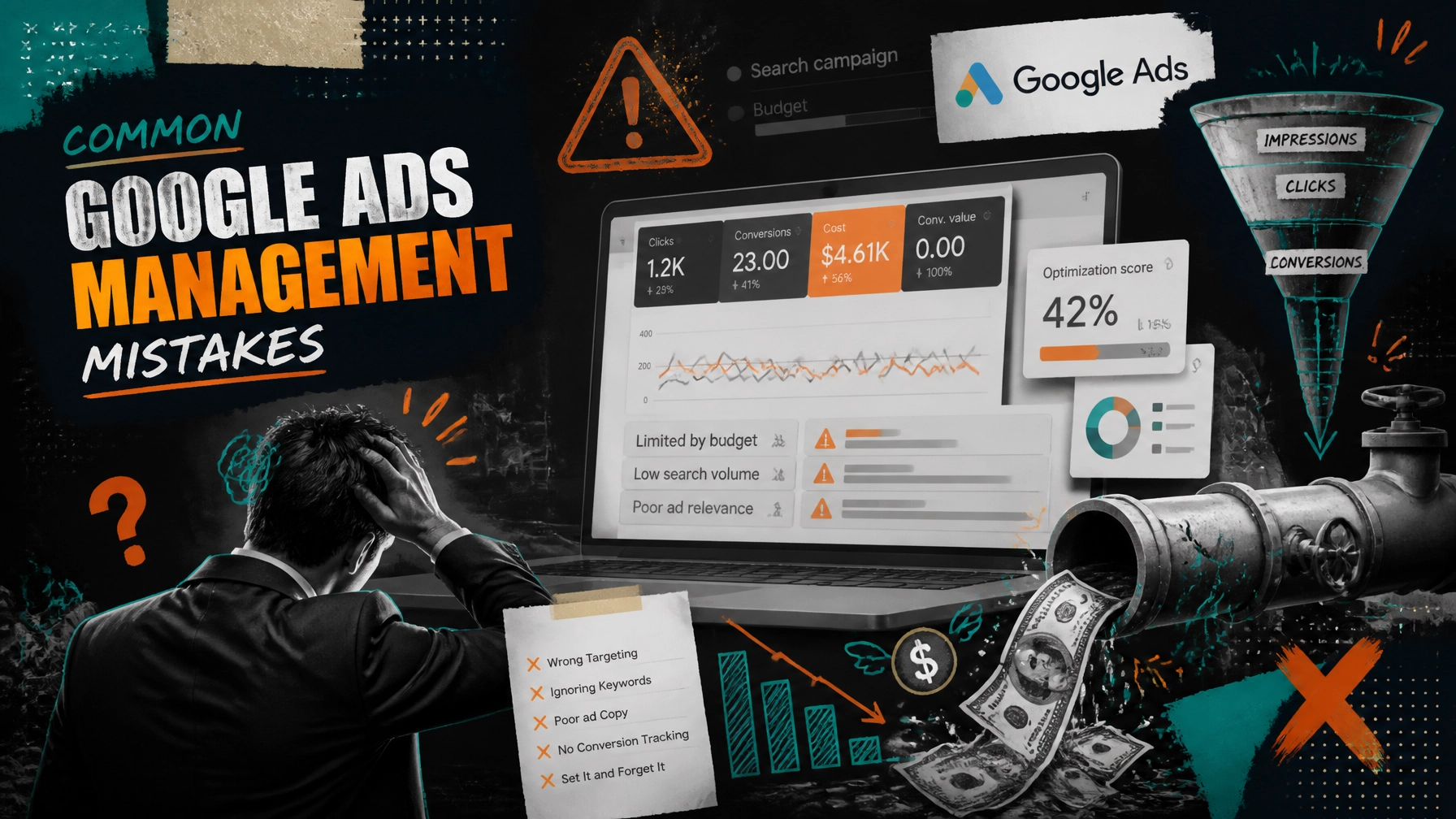
Running Google Ads for a local business or multi-location venue can feel like turning on a high-speed tap. Clicks come in, dashboard impressions tick upward, and monthly invoices arrive like clockwork. Yet, when you check the actual bottom line: new reservations, qualified sales calls, or foot traffic: the math often doesn't add up.
If your ad spend is climbing while your return on investment stalls, your campaigns are likely suffering from silent budget leaks. At Iktika Media, our marketing agency regularly audits accounts for regional businesses, hospitality groups, and multi-location enterprises. We consistently find that performance bottlenecks stem from two core culprits: flawed landing page routing and bidding inefficiencies.
Let’s examine the 7 most common Google Ads management mistakes draining your advertising budget right now: and actionable fixes to turn every dollar into predictable revenue.
1. Sending All Ad Traffic to Your Homepage (Poor Landing Page Routing)
The Mistake
Many business owners treat paid search like organic search, directing every keyword click straight to the corporate homepage. Whether someone searches for "emergency dental clinic open now" or "private dining room for 20 guests," they land on the exact same general homepage.
Why It Wastes Budget
When a user clicks an ad with a specific intent, they expect an immediate, tailored answer. Dropping them onto a generic homepage forces them to hunt for menus, pricing, or booking forms. This friction destroys conversion rates, meaning you pay for dozens of clicks that bounce immediately. Furthermore, Google’s Quality Score algorithms penalize mismatched landing pages, driving up your cost-per-click (CPC).
The Fix
Route high-intent ad groups to dedicated, hyper-focused landing pages. Ensure the headline, primary image, and call-to-action (CTA) directly mirror the user's search intent. For instance, if you want to explore how hyper-local strategies work, review our insights on why local businesses need geofencing and Google Ads.
2. Creating a Message Mismatch Between Ad Copy and Landing Page
The Mistake
Your ad promises a specific promotion, seasonal discount, or urgent solution, but the landing page opens with a completely different headline, corporate jargon, or a buried offer.
Why It Wastes Budget
Users make split-second decisions online. If the visual and verbal continuity breaks the moment they click, cognitive dissonance sets in. They bounce back to search results, wasting your ad spend and sending negative behavioral signals to Google's delivery system.
The Fix
Adopt message stream alignment:
- Mirror your top keyword phrase and ad headline in the landing page’s primary H1 tag.
- Place your primary value proposition and a clear, frictionless booking or inquiry form above the fold.
- Eliminate distracting navigation links on dedicated landing pages to keep users focused solely on conversion.
3. Jumping Into Smart Bidding (Target CPA/ROAS) Too Early
The Mistake
Brand-new accounts or low-volume campaigns often leap straight into advanced automated bidding strategies like Target CPA (Cost-Per-Acquisition) or Target ROAS (Return on Ad Spend) before gathering sufficient historical conversion data.
Why It Wastes Budget
Google’s machine learning algorithms require robust data signals: typically at least 30 to 50 conversions per month per campaign: to optimize effectively. Without enough data, automated bidding erraticizes spend, throttles impressions unpredictably, or chases low-quality traffic.
The Fix
Start with foundational bidding strategies such as "Maximize Clicks" or manual CPC until your account establishes stable, verifiable conversion tracking. Once your campaign consistently generates reliable conversion data over 30 days, transition smoothly to Smart Bidding under the guidance of our ADS specialist, Cecy Madero.

4. Running Broad Match Keywords Without Strict Negative Safeguards
The Mistake
Enabling broad match keywords across campaigns without robust, actively managed negative keyword lists is one of the fastest ways to hemorrhage advertising dollars.
Why It Wastes Budget
Broad match gives Google vast latitude to interpret user intent. Without rigorous guardrails, your ads will appear for irrelevant, low-intent search queries that consume your daily budget without ever converting into revenue. Industry estimates indicate that unmonitored broad match can waste up to 20% of a local business's ad spend.
The Fix
- Review your Search Terms Report weekly.
- Build comprehensive negative keyword lists to proactively block irrelevant terms, competitor brand names (unless intentional), and informational queries that lack commercial intent.
- If utilizing broad match, pair it strictly with Smart Bidding and tightly clustered ad groups.
5. Spreading Budgets Too Thin Across Over-Segmented Campaigns
The Mistake
Many multi-location businesses or eager marketers slice budgets into dozens of micro-campaigns and hyper-specific ad groups, giving each a tiny daily spend.
Why It Wastes Budget
When budgets are fragmented, individual ad groups receive too little data for algorithms to learn. The platform remains permanently trapped in "learning mode," delivering inconsistent performance and inefficient ad delivery.
The Fix
Consolidate your account structure. Combine smaller, low-volume ad groups into broader, high-intent themes. A streamlined structure allows algorithms to aggregate data faster, optimize bids with higher confidence, and lower your overall acquisition costs.
6. Ignoring Mobile Experience and Page Speed
The Mistake
Advertisers invest heavily in optimizing desktop campaigns while sending mobile traffic to slow-loading, clunky pages with tiny form fields and broken buttons.
Why It Wastes Budget
Over 60% of local searches: especially for restaurants, retail, and healthcare: happen on smartphones. If your landing page takes longer than three seconds to load on a mobile device, potential customers abandon ship instantly. You pay for the click, but lose the conversion before the page even renders.
The Fix
- Test your core landing pages using Google’s PageSpeed Insights.
- Ensure sub-2-second load times on mobile connections.
- Design forms with large, tappable buttons and minimal required fields to maximize mobile completions.

7. Tracking Vanity Metrics Instead of True Business Conversions
The Mistake
Measuring Google Ads success by clicks, impressions, or click-through rate (CTR) rather than verified revenue, qualified leads, and actual bookings.
Why It Wastes Budget
High CTRs and low CPCs look impressive in a weekly report, but if those clicks do not translate into real commercial outcomes, your campaign is a financial drain. Furthermore, incorrect conversion tracking misleads automated bidding systems, teaching them to optimize for empty actions like page views rather than high-value customer acquisitions.
The Fix
Align your tracking architecture with real business economics. Configure primary conversion actions for phone calls, form submissions, e-commerce checkouts, or reservation system bookings.
As our agency director Isabel Zetina emphasizes, sustainable growth requires aligning high-level marketing strategy with rigorous, data-backed execution:
"Visibility without conversion tracking is just expensive noise. When you connect your paid media directly to your core revenue systems, every marketing dollar stops being an expense and starts acting as an investment."
Stop Wasting Your Ad Spend: Partner with Iktika Media
Fixing these seven mistakes requires a blend of technical precision, creative copywriting, and disciplined account management. You don't have to navigate complex bidding algorithms and landing page optimization alone.
Explore our comprehensive services or contact our team today to schedule a professional audit of your Google Ads account. Let’s turn your digital presence into a predictable engine for growth.